2026
AvatarBoost A Universal Real-Time Video Enhancement Model for 4D Avatarization
AvatarBoost enhances rendered 4D avatar videos in real time, improving realism while preserving identity, expression, and multi-view consistency.
01
Abstract
High-quality 4D avatarization requires multi-view consistency, identity preservation, and faithful expression control while meeting the efficiency demands of real-time applications. Geometry-based rendering provides multi-view consistency and motion control but can lack realism. Video diffusion can improve realism but is typically slow and does not inherently ensure multi-view or identity consistency. We introduce AvatarBoost, a general-purpose real-time video enhancement model that uses video diffusion to improve outputs from existing 4D avatarization methods. Specifically, it refines rendered videos through a diffusion-based restoration process guided by multiple reference images and facial landmarks. The reference images provide complementary identity and appearance cues, while landmark guidance helps preserve facial expressions and head motion. Together, these conditions guide the model to suppress rendering artifacts and recover fine details while maintaining identity consistency and motion fidelity. Finally, we distill the restoration model into a two-step generator using Distribution Matching Distillation (DMD) to enable real-time video enhancement. Experiments show that AvatarBoost improves visual realism and identity preservation while maintaining multi-view consistency and expression accuracy across diverse head motions and camera trajectories.
- We introduce AvatarBoost, a video enhancement model with a shared rendered-video interface that accommodates different upstream 4D avatar models.
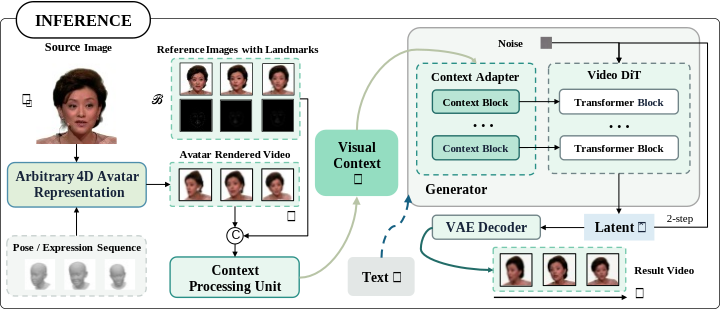
- We develop a conditional restoration model that combines coarse renders, multiple identity references, and landmark-derived facial masks to guide appearance enhancement.
- We develop a two-step distillation scheme for avatar restoration using distribution matching and low-rank adaptation to support efficient inference and parameter-efficient training.
02
Method
AvatarBoost enhances outputs from a range of 4D avatar representations.
03
Results
Representative examples from multi-view and single-view avatar settings.
04
Comparison
Side-by-side comparisons with established avatar methods and two rendering backends enhanced by AvatarBoost.
05
Ablation
The effect of reference-image and landmark guidance on restoration quality.